
Claude Sonnet 5 and Claude Opus 5, as of September 18, 2026, run the identical five effort levels, low through max.
Effort alone no longer explains Opus 5's 2.5 times higher price on every token, input and output alike.
Neither vendor page benchmarks the other. On price per token, Sonnet 5 wins outright.
Model | Output, $/MTok | Input, $/MTok | Context window | Max output | Min. cacheable prompt | Effort levels | Knowledge cutoff | Released |
|---|---|---|---|---|---|---|---|---|
Claude Opus 5 | 25.00 | 5.00 | 1,000,000 tokens | 128,000 tokens | 512 tokens | low, medium, high, xhigh, max | May 2026 | July 24, 2026 |
Claude Sonnet 5 | 10.00 | 2.00 | 1,000,000 tokens | 128,000 tokens | 1,024 tokens | low, medium, high, xhigh, max | January 2026 | June 30, 2026 |
Every cell above was collected from Anthropic's own platform documentation and model pages, not tested by LLM Waves Research.
Output and input prices both carry an exact 5:2 ratio, Opus 5 over Sonnet 5, arithmetic rather than a rounded estimate: $25 divided by $10, and $5 divided by $2.
Both models share the same 1,000,000-token context window and 128,000-token max output, so neither ceiling explains the price gap. The collection date for every figure in this article is 2026-09-18.
Basis and method
The comparison below runs on Basis 2, aggregated figures. Every figure traces to Anthropic's own platform documentation, model overview pages, and launch announcements. None came from a benchmark run by LLM Waves Research this session. Pricing and specifications came from platform.claude.com's per-model overview pages.
Effort-level support came from platform.claude.com's dedicated effort documentation. Benchmark claims came from Anthropic's own Claude Opus 5 and Claude Sonnet 5 announcement pages. Where a figure originates with a source other than Anthropic, it is named in the sentence that uses it, never treated as Anthropic's own claim. Nothing here was measured.
Every number is reported or vendor-stated, tiered accordingly, and dated to a single collection window rather than restated inline sentence by sentence. Full source list and arithmetic sit in the methodology page.
These decision axes rank on price per token, effort-level ceiling, and whether Anthropic's own materials support a direct claim, not on a benchmark held out and run in this session.
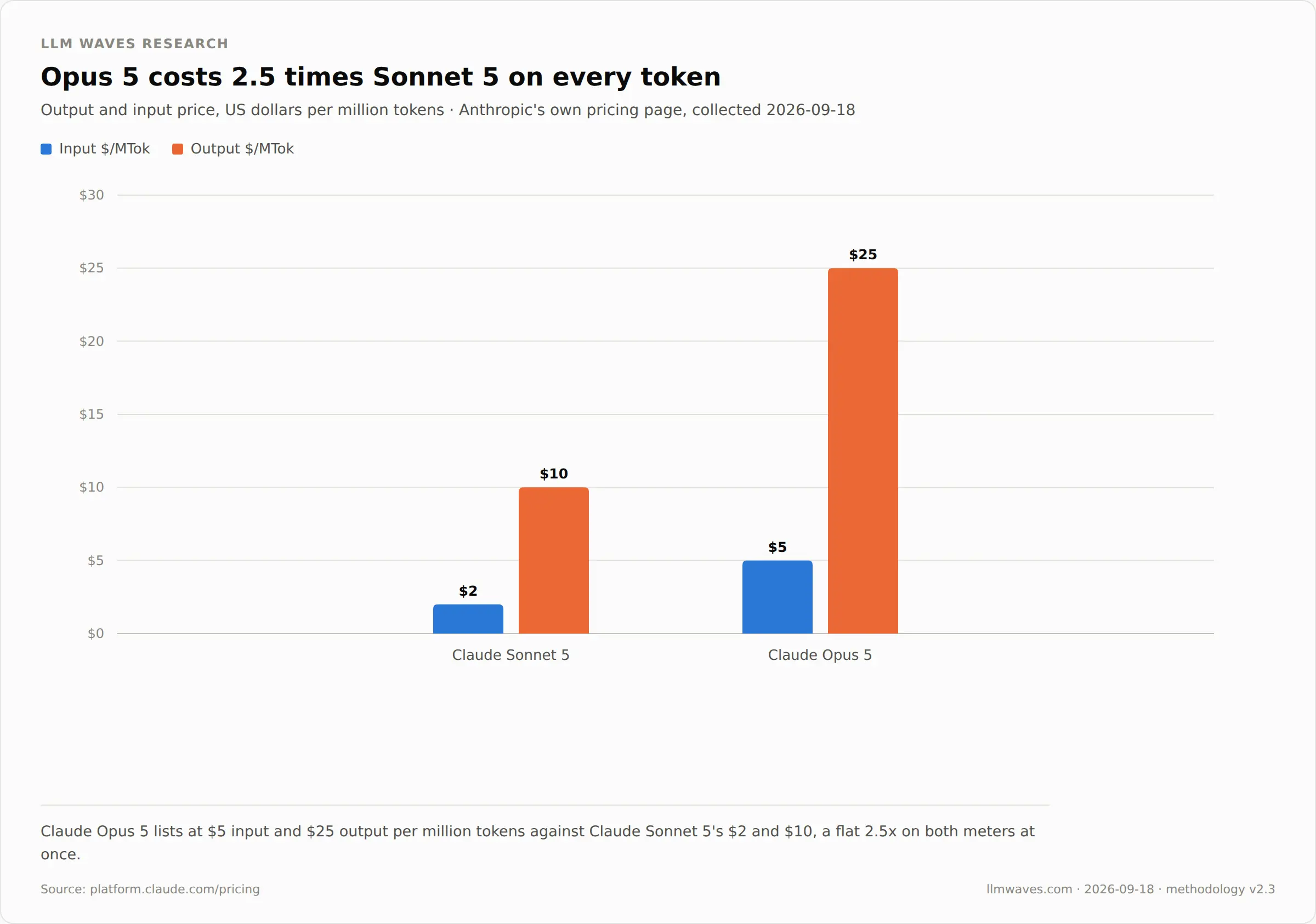
Claude Sonnet 5 costs $2 per million input tokens and $10 per million output tokens on Anthropic's own per-model pricing page.
Claude Opus 5 costs $5 and $25 on the equivalent page, checked the same day.
Neither figure carries a long-context surcharge, since Claude's 4.6-generation pricing structure and later includes the full 1,000,000-token window at the standard rate.
Claude Sonnet 5 closed the effort gap with Opus 5, not the price gap
Effort is the setting that tells a Claude model how much reasoning budget to spend on a given turn, running from low through medium, high, xhigh, and max.
Anthropic's effort documentation lists Claude Sonnet 5 as supporting all five levels, the same ceiling Claude Opus 5 carries. That parity did not exist a generation earlier. Claude Sonnet 4.6 tops out at max with no xhigh rung at all.
This closes the single largest open question around this comparison: whether Sonnet's effort dial can substitute for Opus pricing at the model's own reasoning ceiling. It can.
The two models price that shared ceiling differently, at $10 against $25 per million output tokens. Both default to high effort.
Anthropic's documentation states plainly that effort is a behavioral signal, not a strict token budget. It specifically discloses that changing effort on Claude Opus 5 does not reliably shorten a response.
Low effort trades capability for token savings. Xhigh and max spend more, and per Anthropic's own wording, carry "significant cost" on top of high.
Claude Sonnet 5's minimum cacheable prompt length is 1,024 tokens, exactly double Claude Opus 5's 512-token floor, per Anthropic's prompt caching documentation.
A prompt under that floor is never cached, on either model, and no error is returned when it silently isn't.
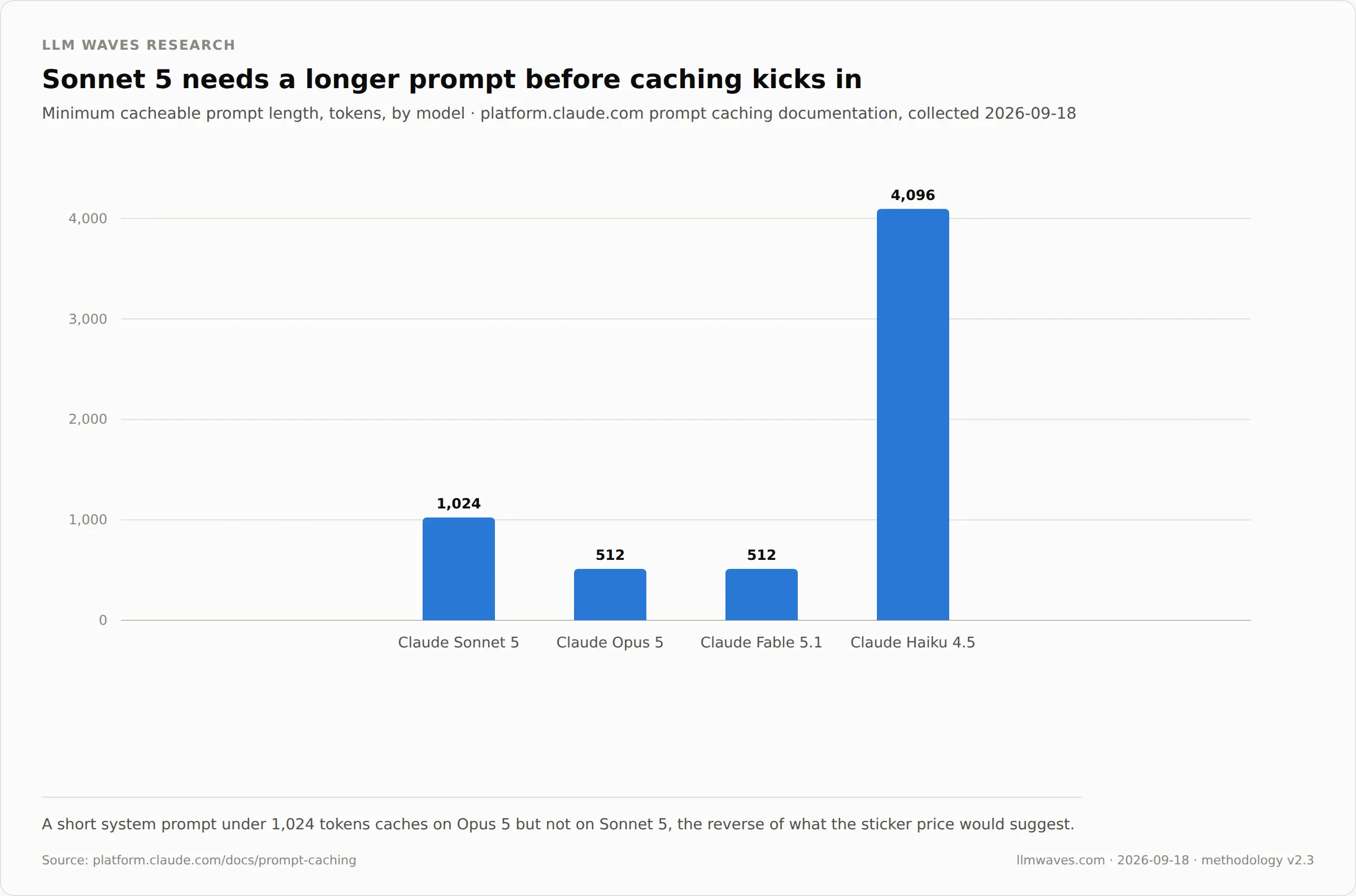
A short tool definition or a brief system prompt can clear Opus 5's 512-token floor and still fall short of Sonnet 5's 1,024-token floor.
A workload built around small, frequently repeated prompts can lose caching entirely on the cheaper model while keeping it on the pricier one. No page in the current search results for this comparison names this asymmetry.
Claude Opus 5 costs 2.5 times more, and neither model's launch page compares it to the other
Claude Opus 5 is Anthropic's higher-priced, higher-ceiling model in the current lineup, released July 24, 2026, 24 days after Claude Sonnet 5.
Its own announcement headlines six named evaluations.
On Frontier-Bench v0.1 it more than doubles Claude Opus 4.8's score. On CursorBench 3.2, max effort lands within half a point of Claude Fable 5's peak at roughly half the cost.
On ARC-AGI-3 it scores three times the next-best model. On Zapier AutomationBench it clears about 1.5 times the next-best model at matching cost. OSWorld 2.0 and GDPval-AA v2 round out the list. SWE-bench Verified is absent from that page entirely.
Claude Sonnet 5's own announcement, published June 30, 2026, headlines BrowseComp, OSWorld-Verified, Humanity's Last Exam, and a Firefox exploit-development evaluation instead.
Every comparison on that page runs against Claude Opus 4.8, the previous generation's Opus, because Claude Opus 5 did not exist yet when Sonnet 5 shipped.
The result: two models Anthropic sells side by side in the same pricing table have never been benchmarked against each other on a single shared chart, by either vendor page.
A reader comparing them on capability is working from two disjoint benchmark sets, not one scoreboard with two bars.
The current Claude Opus 5 model page tracks whether that changes.
Claude Sonnet 5's knowledge cutoff is January 2026. Claude Opus 5's is May 2026, four months later, a gap that tracks the models' own release order rather than any deliberate staggering.
What effort actually buys, and why no clean price per task exists
A cost-per-completed-task figure would need a stable ratio between effort level and output token volume. Anthropic does not publish one. Its own effort documentation states plainly that effort is a behavioral signal, not a strict token budget.
It adds that changing effort on Claude Opus 5 does not reliably shorten a response, the opposite of what a fixed multiplier would assume.
That single disclosure rules out the tidy "xhigh costs 1.4x high" tables several sites publish for other vendors.
No such multiplier exists here. Anthropic has not published one for either model, and this article did not measure one either.
What can be stated as arithmetic, not measurement, is the flat per-call gap at fixed token counts.
Take a 10,000-input, 2,000-output call. That costs $0.04 on Claude Sonnet 5 and $0.10 on Claude Opus 5, the same 2.5x ratio the sticker prices carry.
Scale it to 100,000 input and 20,000 output tokens and the gap holds exactly: $0.40 against $1.00.
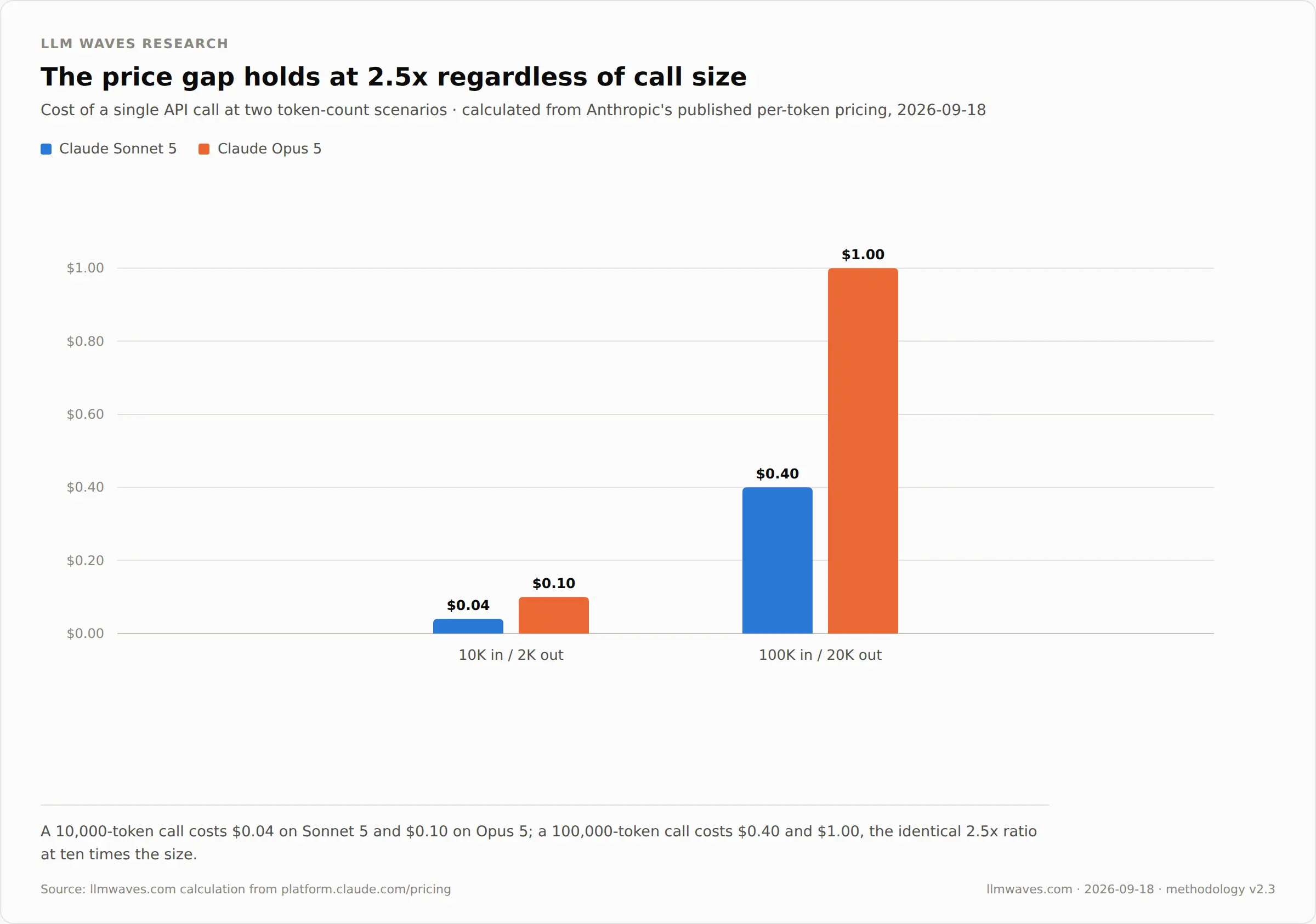
The ratio is constant because the sticker price is constant. What is not constant, and not disclosed by Anthropic for this model pair, is how many output tokens a given task actually consumes at each effort level, which is the variable that would turn a price-per-token comparison into a price-per-task one.
The Claude API pricing breakdown covers cache, tool, and managed-agent meters that sit on top of this base rate for both models.
Fable 5.1 and Mythos 5.1 now sit above Opus 5, and only one of them ships to everyone
Claude Fable 5.1 and Claude Mythos 5.1 are the tier above Claude Opus 5 in Anthropic's current lineup, both announced September 2026, both priced at $10 input and $50 output per million tokens, twice Opus 5's rate.
A reader comparing Claude against other vendors' current flagships, not only against itself, should note that the Claude vs ChatGPT vs Gemini comparison uses Opus 5, not Fable 5.1, as Claude's entry.
Claude Fable 5.1: generally available
Claude Fable 5.1 ships across the Claude API, Amazon Bedrock, Google Cloud, and Microsoft Foundry. Anyone who can call Claude Opus 5 can call Claude Fable 5.1 at double the rate.
Claude Mythos 5.1: restricted to vetted programs
Claude Mythos 5.1 is not generally available. Anthropic restricts it to vetted participants in its Cyber Verification Program and Life Sciences Verification Program.
There is no public API access and no published price for most readers to compare against.
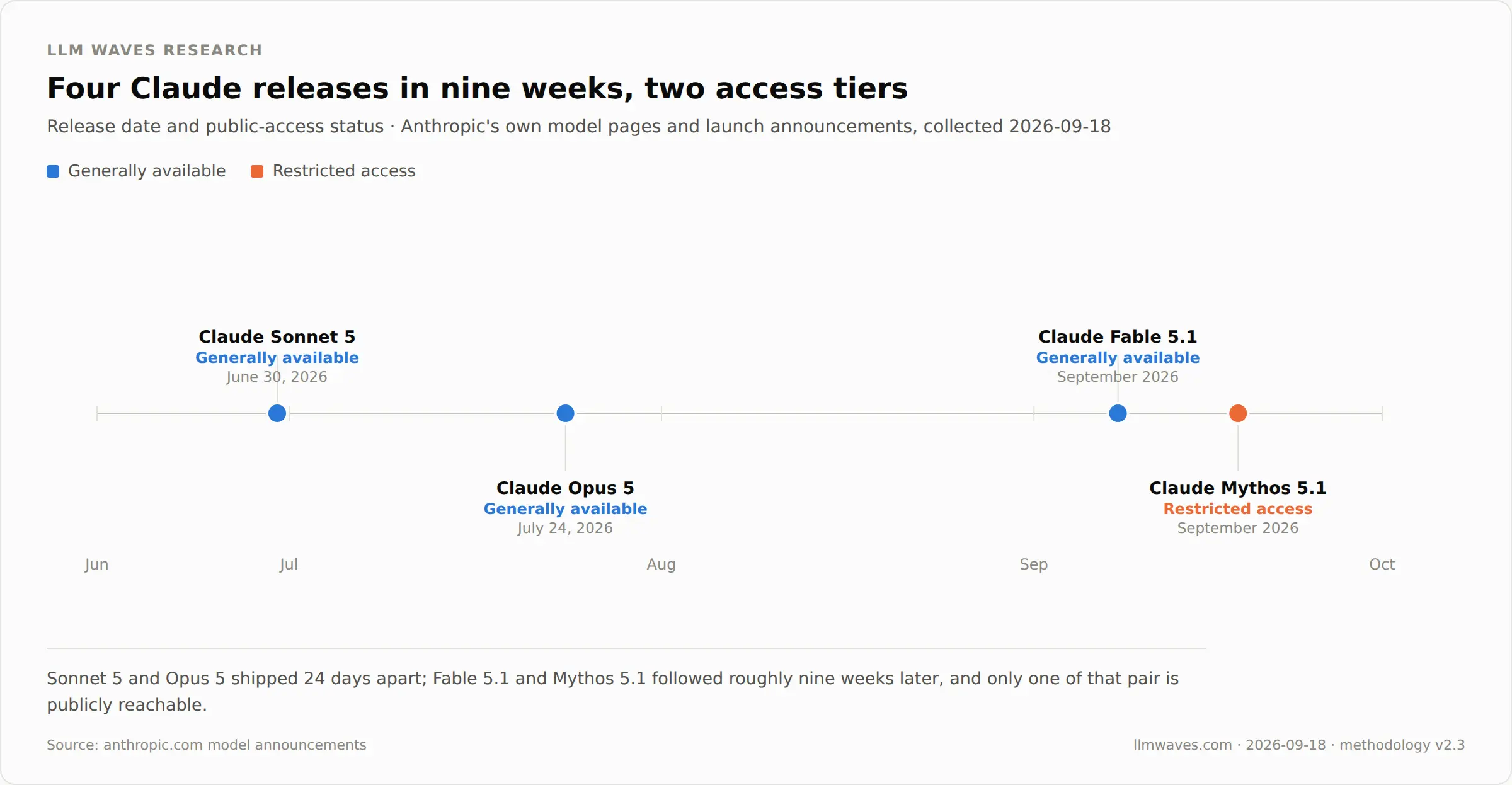
A reader who searches "is Opus the best Claude model" lands on a wrong premise. Claude Opus 5 is only the best model most people can actually call through the API, at $25 output per million tokens.
Fable 5.1 costs more and sits above it for anyone who can reach it. Mythos 5.1 sits beside Fable 5.1, reachable only by a narrow, vetted group Anthropic names by program, not by price.
This article did not run a latency test, a throughput test, or an output-quality benchmark against any model discussed.
Which model for which reader
Segment | Verdict | Why |
|---|---|---|
For developers | Situational | Sonnet 5 covers most agentic coding at any effort level up to max; reach for Opus 5 only on the tasks Anthropic's own Frontier-Bench and CursorBench claims describe. |
For startups | Best value | 2.5x lower cost at the identical five-level effort ceiling. |
For enterprise | Situational | Opus 5 if the workload needs the higher ceiling regardless of price; Sonnet 5 otherwise, since no shared benchmark separates them cleanly. |
For high volume | Best value | Sonnet 5's flat 2.5x discount compounds at scale; its 1,024-token cache floor is the one number worth checking against actual prompt length first. |
For low latency | Insufficient data | This article ran no latency test on either model. |
For on-device | Not recommended | Neither model ships open weights. |
For self-hosting | Not recommended | Neither model ships open weights. |
For non-English | Insufficient data | Neither vendor page in this comparison discloses a non-English score for either model. |
Sonnet 5 leads on price and effort-level access at every tier that matters to a budget-constrained reader; Opus 5's case rests entirely on the higher ceiling Anthropic claims on its own launch benchmarks, unverified against Sonnet 5 by either company.
Can you actually tell Sonnet and Opus apart in practice
Effort level is the practical dial that used to separate the two models and no longer fully does. Both now expose the same five settings, so a reader running Sonnet 5 at max effort is using the identical ceiling Opus 5 exposes at max, priced 2.5 times lower per output token.
What still separates them is the untested claim: Anthropic's own Frontier-Bench, ARC-AGI-3, and CursorBench figures describe Opus 5 pulling ahead of prior Anthropic models at a given effort setting, a comparison this article did not run, and Anthropic has not run against Sonnet 5 directly.
Does Sonnet 5 actually support xhigh and max effort, or does it cap lower
Claude Sonnet 5 supports both. Anthropic's effort documentation lists Sonnet 5 among the models carrying all five levels, low through max, matching Claude Opus 5's ceiling and exceeding Claude Sonnet 4.6, which stops at max with no xhigh rung.
What's the minimum cacheable prompt length for each model, and why does it matter
Claude Sonnet 5 requires 1,024 tokens before a prompt caches; Claude Opus 5 requires 512. A prompt shorter than the floor is silently served uncached, at full input price, with no error returned, so a short repeated system prompt can lose its caching discount on the cheaper model while keeping it on the pricier one.
Is there a model above Opus now
Yes. Claude Fable 5.1 and Claude Mythos 5.1 both sit above Claude Opus 5 in price, at $10 input and $50 output per million tokens. Fable 5.1 is generally available; Mythos 5.1 is restricted to Anthropic's Cyber Verification Program and Life Sciences Verification Program participants.
Is Claude Opus 5 available on the free plan
Anthropic's own pricing and model pages, checked 2026-09-18, describe Claude Opus 5 as an API and paid-plan model; no free-tier access is listed on the pages this article checked.
Two models, one price sheet, and a benchmark gap Anthropic hasn't closed
Both models will move at least one figure on this page before Anthropic's next Claude release, and neither company has yet published the one chart that would put Sonnet 5 and Opus 5 on the same axis. Until it does, the 2.5x price ratio is the cleanest number either vendor has actually confirmed.
Full pricing, effort-level, and specification data behind every figure in this article: https://llmwaves.com/methodology