Qwen3.6 27B is the top scored local model for OpenClaw on Ollama. Its Agentic Index is 27.5, against 3.1 for gpt-oss-20b.
On Ollama Cloud, Kimi K3 leads at 54.3 and costs $1.35 per task.
Table 1: Agent score, download size, and Ollama Cloud cost for 10 models, ordered by Agentic Index. Data collected 2026-10-06 to 2026-10-07 (UTC).
Model and Ollama tag | Agentic Index | Intelligence Index | Coding Index | Runs on | Download (GB) | Cost per task (USD) |
|---|---|---|---|---|---|---|
Kimi K3 | 54.3 | 59.7 | 76.2 | Cloud | n/a | 1.3500 |
GLM 5.2 | 45.7 | 52.6 | 68.8 | Cloud | n/a | 0.4220 |
DeepSeek-V4-Pro | 37.8 | 45.3 | 59.4 | Cloud | n/a | 0.3828 |
Qwen3.6 27B | 27.5 | 37.7 | 53.7 | Local | 18 to 19 | n/a |
MiniMax M2.7 | 25.9 | 38.9 | 52.6 | Cloud | n/a | 0.1110 |
Qwen3.6 35B A3B | 21.6 | 32.1 | 41.9 | Local | 23 to 24 | n/a |
gpt-oss-120b | 13.4 | 24.1 | 30.4 | Local and cloud | 65 | 0.0555 |
Qwen3.5 35B A3B | 11.8 | 29.9 | n/a | Local | 22 | n/a |
Qwen3.5 9B | 7.0 | 21.8 | 28.7 | Local | 6.6 to 7.6 | n/a |
gpt-oss-20b | 3.1 | 15.2 | 20.7 | Local and cloud | 14 | 0.0275 |
Table note: n/a marks a column that does not apply to that row, or a score the LLM Waves listing does not show. Cost per task uses Ollama list prices for 50,000 input and 80,000 output tokens with no caching, and DeepSeek-V4-Pro shows the peak rate.
The off-peak rate gives 0.1914 USD per task. Scores belong to the models as indexed.
Qwen3.6 27B scores 27.5 at an 18 to 19 GB download. gpt-oss-20b scores 3.1 at 14 GB. Kimi K3 reaches 54.3 in the cloud, where the Ollama pricing page lists $3.00 per 1M input tokens and $15.00 per 1M output tokens.
That prices one task at $1.35. DeepSeek-V4-Pro posts 37.8 and runs $0.3828 per task at the peak rate.
How the figures were collected
Prices, download sizes, and settings come from the Ollama and OpenClaw sources linked in each section. Index scores come from the LLM Waves listing for each model.
The methodology page lists the benchmarks and publishes no index weights. Cost per task is arithmetic.
It uses 50,000 input tokens and 80,000 output tokens at the Ollama list rate per 1M tokens, with no caching.
LLM Waves Research did not run these models.
How the 10 models are ordered
The list ranks models on the Agentic Index first, then on cost per task and download size.
Three cloud models score above every local download. One cloud model sits below the best local one.
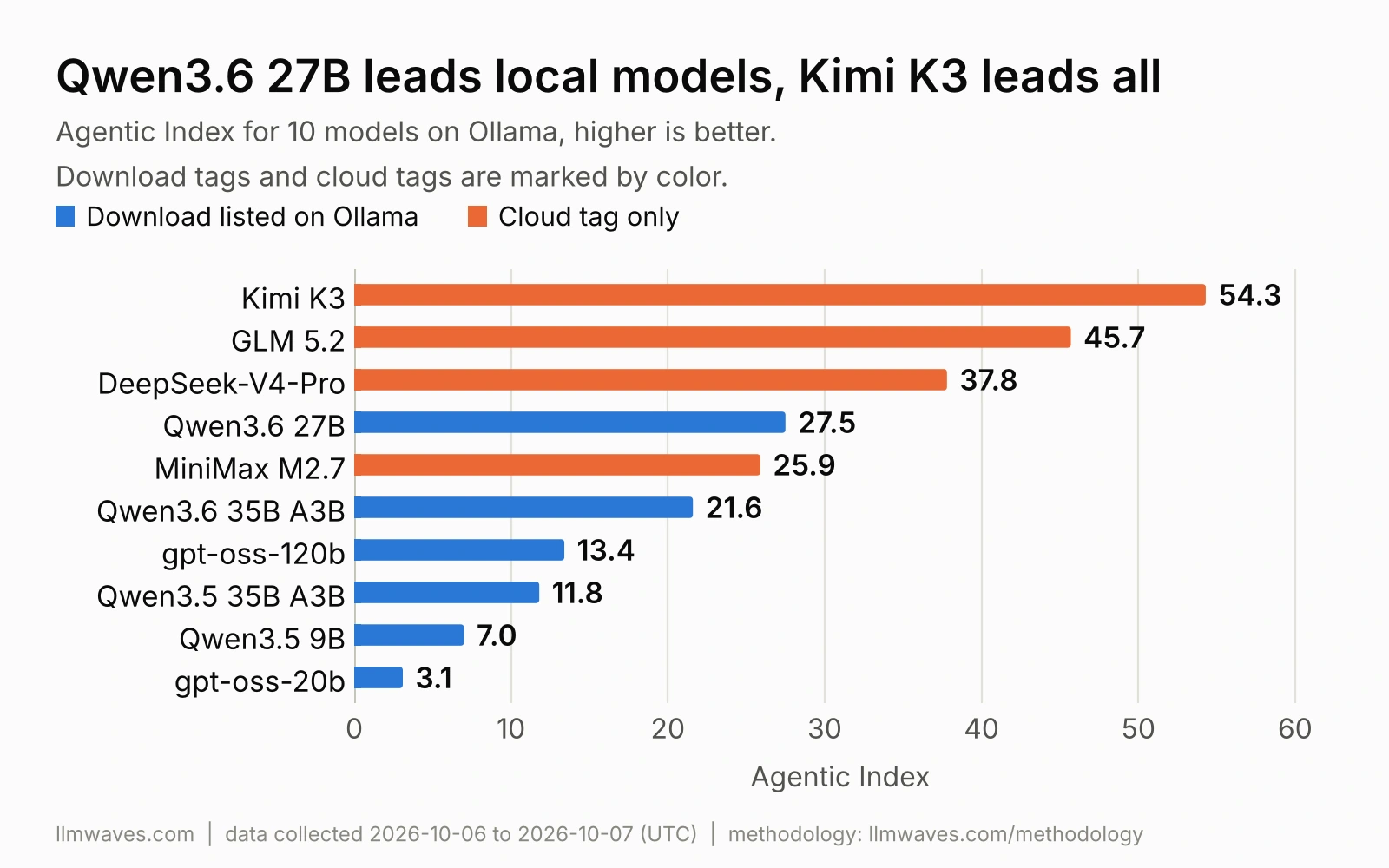
DeepSeek-V4-Pro, the lowest of the three cloud leaders, sits 10.3 points above Qwen3.6 27B.
Qwen3.6 27B scores 24.4 points above gpt-oss-20b for 4 to 5 GB more download
Qwen3.6 27B scores 27.5 on the Agentic Index, according to its LLM Waves page. Its Intelligence Index is 37.7, and its Coding Index is 53.7. The download is 18 to 19 GB.
gpt-oss-20b scores 3.1 and downloads at 14 GB, per the Ollama library listing for gpt-oss. The gap is 24.4 points for 4 to 5 GB of extra download.
Qwen3.6 35B A3B takes more disk space and ranks lower. Its 23 to 24 GB download scores 21.6, which is 5.9 points below Qwen3.6 27B.
Downloads under 16 GB
Two scored options download at under 16 GB. Qwen3.5 9B downloads at 6.6 to 7.6 GB and scores 7.0. gpt-oss-20b downloads at 14 GB and scores 3.1. Gemma 4 carries no rank.
LLM Waves shows no Agentic Index for Gemma 4 26B A4B or Gemma 4 31B.
Ollama's OpenClaw guide gives gemma4 at about 16 GB and qwen3.5 at about 11 GB, and names no build. The untagged downloads are smaller. gemma4:latest is the e4b build at 6.6 to 9.5 GB.
qwen3.5:latest is the 9b build at 6.6 to 7.6 GB. The 16 GB figure sits closest togemma4:26b, which downloads at 16 to 19 GB.
Downloads from 17 to 24 GB
Four downloads sit in this band: Qwen3.5 27B at 17 to 20 GB, Qwen3.6 27B at 18 to 19 GB, Qwen3.5 35B A3B at 22 GB, and Qwen3.6 35B A3B at 23 to 24 GB.
Qwen3.5 27B has an Intelligence Index of 34.6 and no Agentic Index, so it carries no rank. Qwen3.6 27B leads the three ranked downloads, at 27.5 against 21.6 and 11.8.
Across the six scored local downloads, size and score show no steady link.
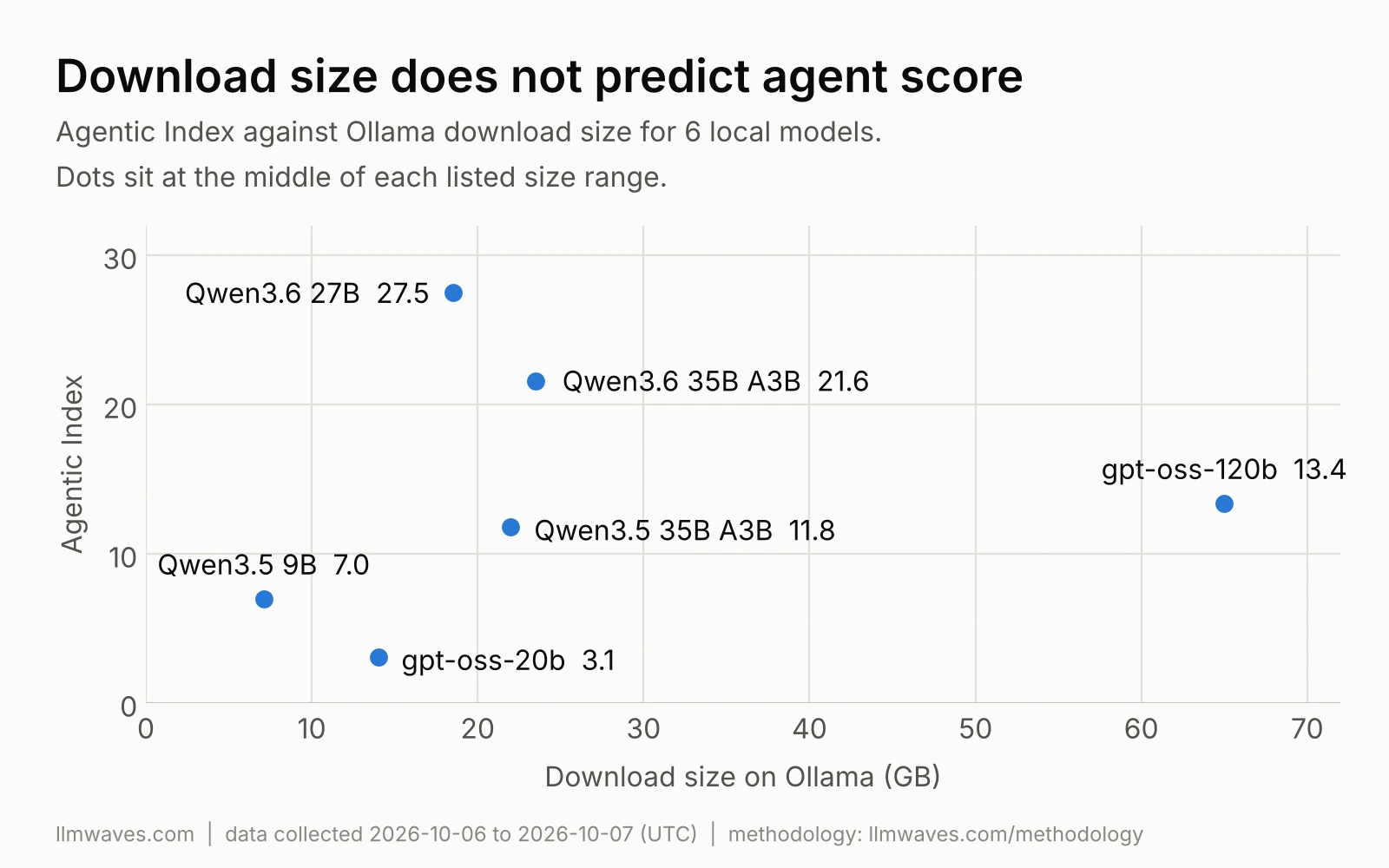
Memory use at 64,000 context was not measured, so download size is the only size figure here.
Downloads above 60 GB
gpt-oss-120b downloads at 65 GB and scores 13.4. An 18 to 19 GB download reaches 27.5, more than twice that.
A base URL that ends in /v1 breaks tool calling
The OpenClaw Ollama documentation states: "Do not use the /v1 OpenAI-compatible URL (http://host:11434/v1). It breaks tool calling, and models can emit raw tool-call JSON as plain text."
The native base URL ishttp://host:11434, with no /v1.
The troubleshooting guide lists "Model outputs tool JSON as text". It names "api": "ollama" with the Ollama baseUrl as the fix.
For a model that struggles with tool schemas, it names "compat.supportsTools": false. For a cold local model that times out, it names "timeoutSeconds": 300 and "keep_alive": "15m".
The model discovery reference gives a smoke test that skips the agent: OLLAMA_API_KEY=ollama-local openclaw infer model run --local --model ollama/llama3.2:latest --prompt "Reply with exactly: pong" --json.
Context comes from params.num_ctx first, and Ollama defaults to 4k below 24 GiB
The OpenClaw advanced reference sets the order for the request context window. It runs params.num_ctx first, the model's contextTokens second, and Ollama's own default last.
It adds that "Local discovery normally caps contextTokens at 32,768 (or the model's smaller native window)." The field contextWindow does not appear in that order.
Ollama's own default depends on graphics memory. The Ollama context length reference lists 4k below 24 GiB, 32k from 24 to 48 GiB, and 256k at 48 GiB or more.
It states that agents "should be set to at least 64000 tokens". It gives OLLAMA_CONTEXT_LENGTH=64000 ollama serve for that size. The CONTEXT column of ollama ps shows the tokens allocated to a running model.
Ollama's default falls below the advised size on two of the three memory tiers.
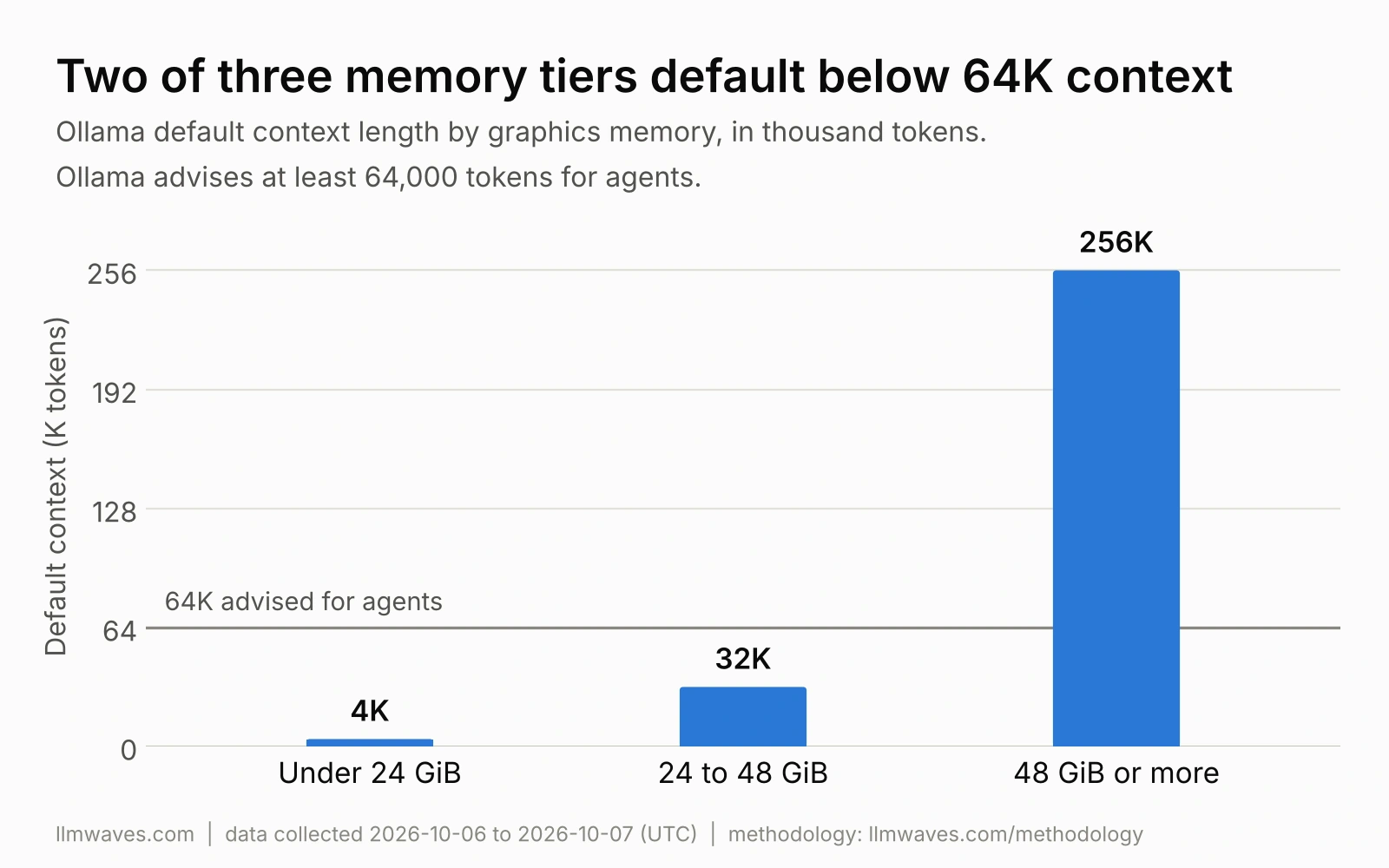
A machine under 48 GiB starts below the advised size unless a setting raises it.
The troubleshooting guide sets both contextTokens and params.num_ctx to 32768 for a large context model that runs out of memory.
One month of Pro credit pays for 44 Kimi K3 tasks or 2,181 gpt-oss-20b tasks
Ollama's August 31, 2026 pricing post moved cloud billing from GPU time to token prices. It states that the new pricing has no service fees and no 5 hour or weekly limits.
Ollama's pricing page lists Pro at $20 a month with $60 of credit. Max is $100 with $300 of credit.
Team is $500 with $1,000 shared. Credits reset each month and do not roll over. Pro carries a limit of three concurrent requests, Max and Team carry 10, and Free carries one.
One task here is 50,000 input tokens and 80,000 output tokens. For gpt-oss:20b, Ollama lists $0.07 per 1M input tokens and $0.30 per 1M output tokens.
Input is 0.05 of 1M tokens, which is $0.0035. Output is 0.08 of 1M, which is $0.024.
One task totals $0.0275. Pro's $60 divided by $0.0275 is 2,181 whole tasks.
Kimi K3 lists $3.00 and $15.00, so a task totals $0.15 plus $1.20, which is $1.35, and Pro's $60 covers 44 tasks.
The same $60 buys a different number of tasks on each cloud option.
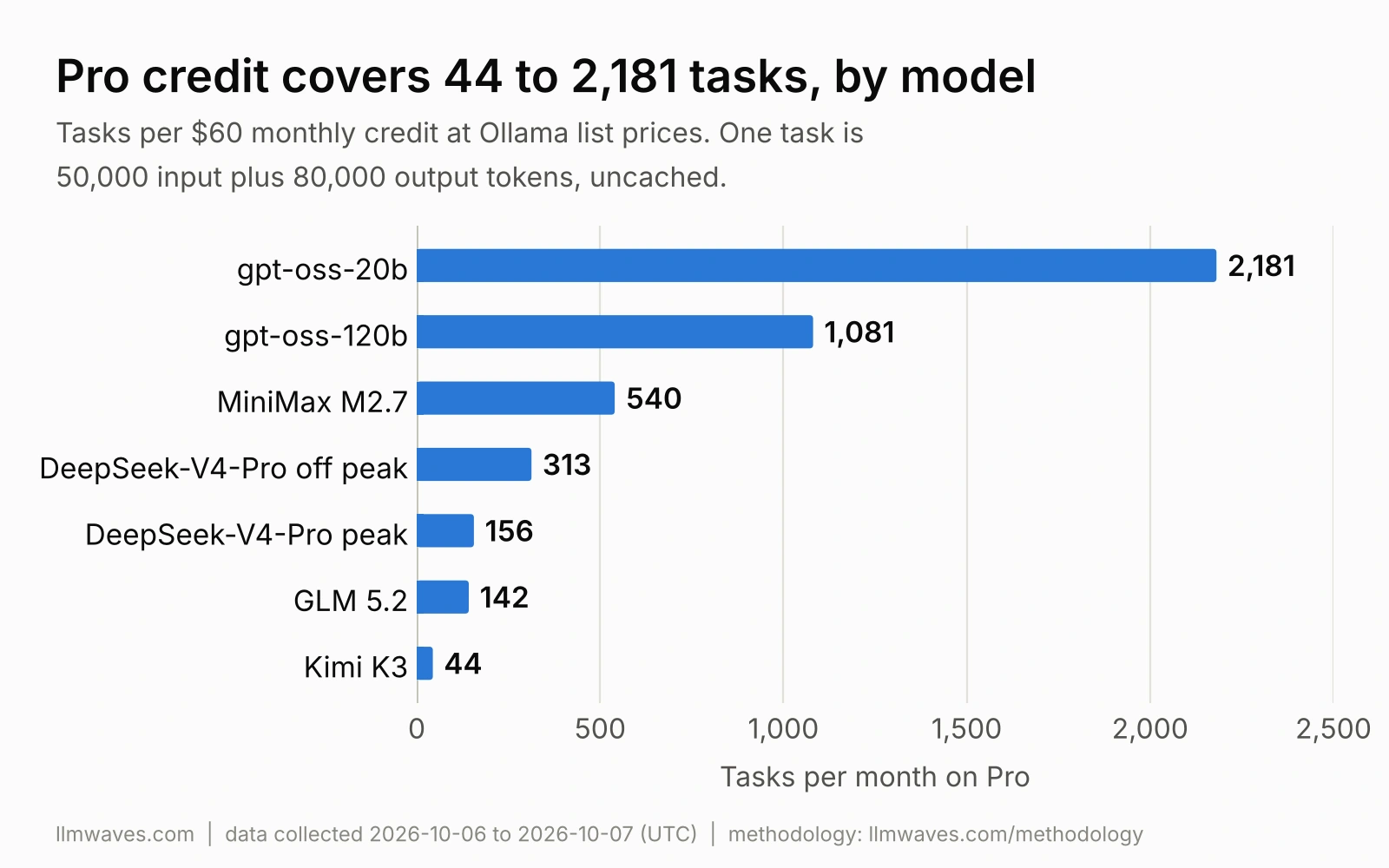
Max's $300 covers 10,909 tasks on gpt-oss-20b and 222 on Kimi K3.
Cost per Agentic Index point separates the cloud rows.
Each figure is the cost per task divided by the index. gpt-oss-120b is $0.0041, and MiniMax M2.7 is $0.0043, the two lowest.
GLM 5.2 is $0.0092. DeepSeek-V4-Pro is $0.0101 at peak and $0.0051 off peak. Kimi K3 is $0.0249.
DeepSeek-V4-Pro carries $1.32 input and $3.96 output at peak on Ollama, and $0.66 and $1.98 off peak. These match the rates in the LLM Waves DeepSeek API pricing article.
The two sources set the off-peak window differently.
Ollama lists "Outside 12:00 and 18:00 UTC on weekdays and all day on weekends".
The DeepSeek article lists peak hours of 01:00 to 04:00 and 06:00 to 10:00 UTC every day. The two clocks do not match.
An idle OpenClaw bills $0.50 to $432.00 in input tokens over 30 days
The OpenClaw heartbeat reference sets the default interval at 30 minutes. It sets 1 hour when Anthropic OAuth or token auth is configured.
Each heartbeat is an agent turn. A turn uses about 100,000 tokens with full history and about 2,000 to 5,000 tokens with isolatedSession: true.
At the 30 minute default, an agent runs 48 heartbeats a day. That is 1,440 in 30 days. At 100,000 tokens a run, that is 144 million tokens.
At 5,000 tokens a run, it is 7.2 million. Priced at the input rate, with no caching and no output charge, 144 million tokens cost $10.08 on gpt-oss-20b, $43.20 on MiniMax M2.7, $201.60 on GLM 5.2 and $432.00 on Kimi K3.
At 5,000 tokens per run, the same four cost $0.50, $2.16, $10.08, and $21.60.
Run size and the chosen option together set the idle bill.
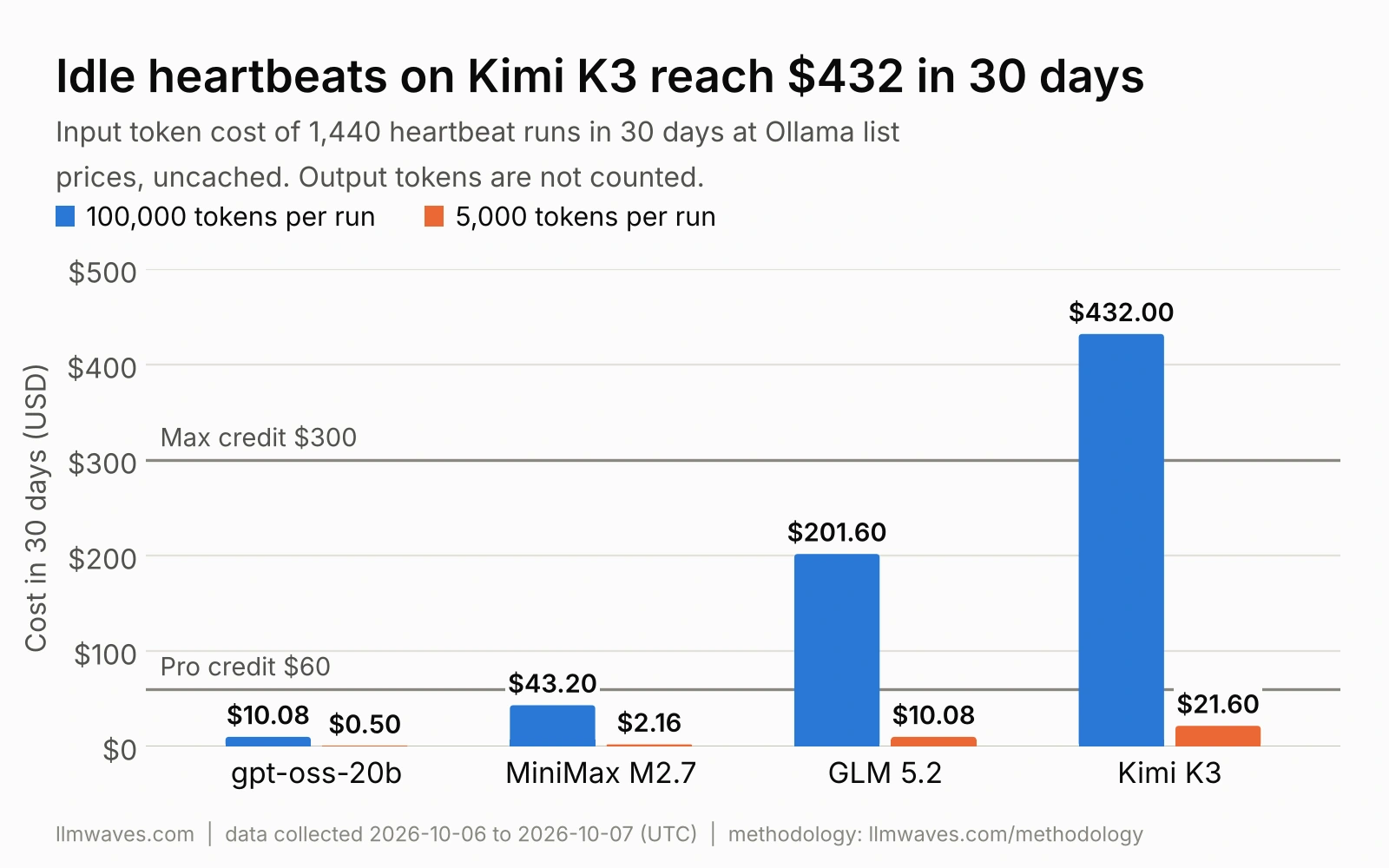
Only one bar passes the Max line. At 5,000 tokens a run, every bill is one twentieth of the 100,000 token bill.
The same reference names agents.defaults.heartbeat.model for sending heartbeats to another model, lightContext for skipping workspace bootstrap files and heartbeat.every: "0m" for turning off the recurring cadence only.
What we did not measure on these models
We did not measure memory use at 64,000 context. We did not measure tokens per second or tool call success on any machine. LLM Waves Research did not run these models, so every score is the figure in its LLM Waves listing, for the model as indexed.
That listing gives Qwen3.6 27B at 27.8B parameters. At 16 bits each that would take about 56 GB, and the Ollama download is 18 to 19 GB. The download is therefore a compressed build, and the index scores may not match it.
The methodology page does not say which benchmarks make up the Agentic Index. This article cannot say which tests drive it. The Agentic Index is a score and not a tool call pass rate. The OpenClaw model discovery reference records "All costs are 0" for discovered Ollama models. We did not check how OpenClaw's own cost view reports Ollama Cloud use.
Which option fits which machine and budget
Memory of 16 GB or less. Situational: Qwen3.5 9B leads the scored downloads under 16 GB, at 7.0 against 3.1 for gpt-oss-20b. A 7.0 is low for long agent tasks. The cloud rows in Table 1 score 25.9 to 54.3.
Graphics card with 24 GB, or shared memory of 32 GB. Top pick: Qwen3.6 27B scores 27.5, which is 5.9 points above Qwen3.6 35B A3B, and its download is 4 to 6 GB smaller. Memory use at 64,000 context was not measured, so a 24 GB card can still fall short.
Cloud, highest score. Top pick: Kimi K3 scores 54.3, which is 8.6 points above GLM 5.2 at 45.7, and costs $1.35 per task. Pro covers 44 such tasks. A 100,000-token heartbeat on Kimi K3 would bill $432.00 in 30 days, above the $300 Max credit.
Cloud, lowest cost per point. Best value: MiniMax M2.7 costs $0.0043 per Agentic Index point, level with gpt-oss-120b at $0.0041, and scores 25.9 against 13.4. Pro covers 540 tasks on MiniMax M2.7.
Always on agent. Situational: for heartbeats alone, gpt-oss-20b costs $0.50 in 30 days at 5,000 tokens per run, against $21.60 on Kimi K3. A score of 3.1 is low for any task that acts on what a heartbeat finds.
Low latency. Insufficient data: no figure here measures OpenClaw response time on Ollama, so no option carries a rank.
No rank. Insufficient data: Gemma 4, Qwen3.5 27B and Nemotron 3 Super have no Agentic Index on LLM Waves. Ollama lists
glm-5.3at the same price asglm-5.2, and LLM Waves has no page for GLM 5.3.
Which Ollama model is best for OpenClaw?
Qwen3.6 27B is the top scored local download, and Kimi K3 is the top scored cloud row. The answer changes with memory and budget.
The sections above give the score, download size and cost for each.
Is OpenClaw with Ollama free?
Running models on your own hardware is always unlimited, according to the Ollama pricing page. Cloud use draws on plan credits first and then on purchased credits.
The Free plan includes starter credits and starter models. Ollama does not name them.
What is OpenClaw vs Ollama?
OpenClaw is the assistant. Ollama is the program that serves the model OpenClaw calls.
OpenClaw sends its requests to the native Ollama API.
Why does OpenClaw print tool calls as text?
The OpenClaw documentation names the /v1 address as a cause. It breaks tool calling, and models can emit raw tool call JSON as plain text.
If the base URL ends in /v1, the documented fix is the native address with api set to ollama.